

Why Should Organizations Care About Trauma?

Your team is filled with people who are experiencing the impacts of trauma in their life and at work.
Even if an Indvidual doesn’t personally experience trauma, they likely are impacted by the traumatic experiences of their spouses, children, parents, and other loved ones.
According to the National Council for Mental Wellbeing, at least 70% of US Adults self-identify as having one or more traumatic experience in their lifetime.
With an issue this pervasive, why aren't we talking about the impacts of trauma on the workplace and team culture?
Trauma informed workplaces create awareness around the existence of trauma, actively avoid retraumatizing survivors of trauma, and creating new traumatic experiences. They DO NOT ever seek to diagnose or treat employee trauma, that should be left to third-party, credentialed professionals.
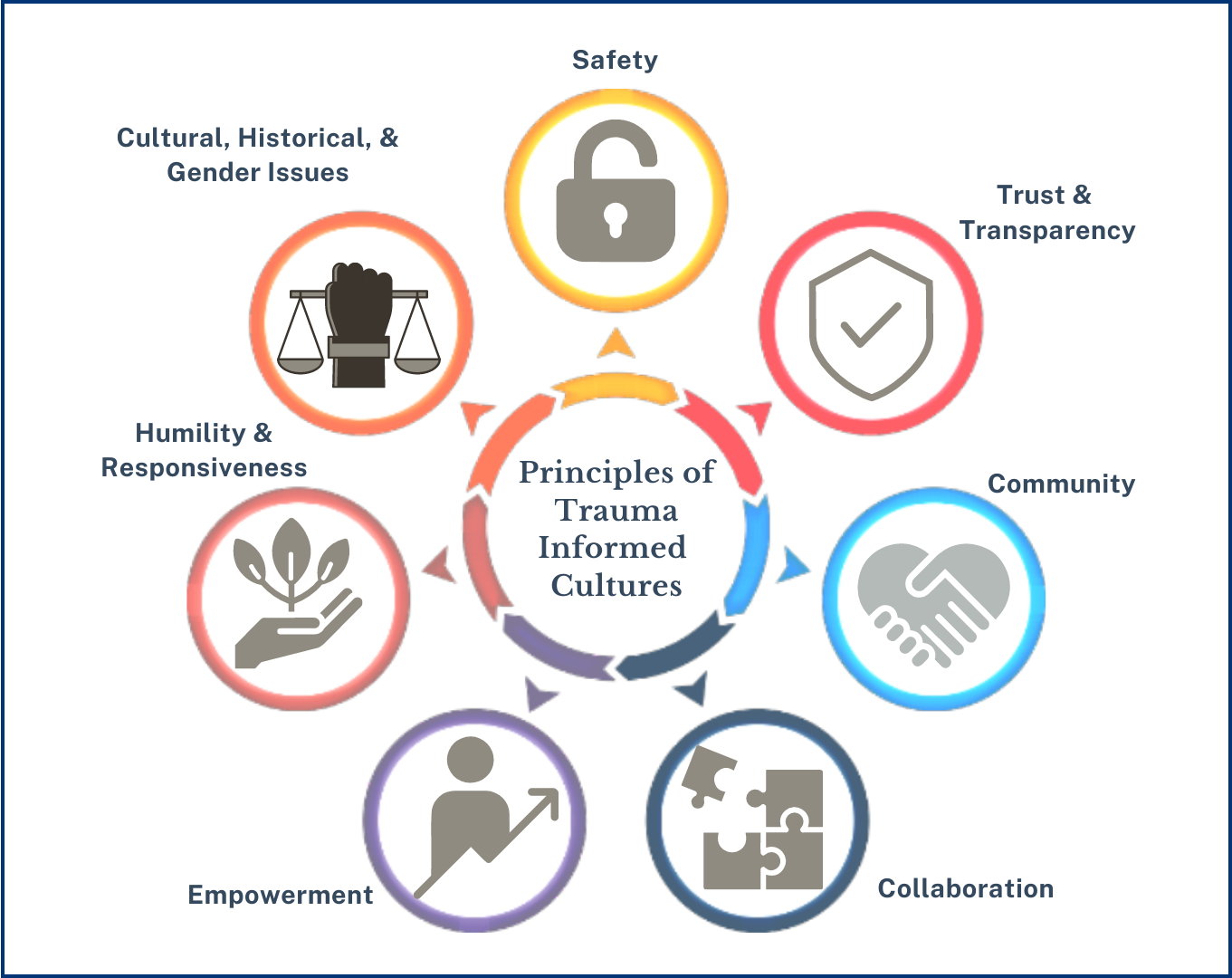
To build Trauma Informed Workplace cultures, we rely on the seven principles of trauma informed cultures, adapted from the SAMSHA Principles of Trauma Informed Care, to focus specifically on the workplace. These principles help support everyone's success regardless of trauma status.

The truth is, many of us don't want to talk about our traumatic experiences at work or may not make connections between past trauma and current challenges. And that's perfectly okay! Organizations don't need either to effectively address trauma in the workplace, what they need is Trauma Informed Workplace Cultures.
The Seven Principles of Trauma Informed Workplace Cultures
-
Safety is the foundation of a trauma informed culture; because when we are unsafe, it’s hard to be focused on much else. As we look at Safety in the context of trauma informed workplaces, it is best represented by a three-legged stool. Safety is built by the three legs of physical safety, psychological safety, and financial safety. If any of the three are missing or damaged- your stool won’t work and you won’t be able to build a robust, trauma informed culture on it.
-
Trust exists within various relationships and to build a trauma informed culture, you must seek to build trust at every level within the organization- peer to peer, within a team, employee to manager, team to leader, among teams, and for the organization as a whole.
Transparency is an excellent tool to build trust. Sharing information in and open, candid and frequent way with your team helps them understand what is going on in the organization and helps them better connect their roles to the company overall.
-
A strong, supportive community can buffer against the negative effects of trauma. When individuals have access to supportive relationships, such as family, friends, trusted co-workers, or community groups, they are more likely to receive emotional support, understanding, and validation. Connecting with others who have gone through similar experiences can make you feel understood and realize your reactions and emotions are valid. A supportive community can also be pivotal in rebuilding trust.
In the context of the workplace, community refers to a sense of belonging, connection, and mutual support among employees within the organization. It is a collective identity that extends beyond individual roles and departments, and many communities exist within a single organization.
-
Collaboration is key to a trauma informed culture, tackling the challenge of power imbalances and how those imbalances can be misused to harm or traumatize others. By acknowledging and addressing power, you create a much better environment for everyone on your team.
-
Because a feeling of lack of control or helplessness can be so tied to trauma, empowerment is one of the most important principles in creating a trauma informed workplace culture.
Empowerment in the context of a trauma informed workplace is about more than choice, it is also about environments where individuals feel valued and that they are making a meaningful contribution. For that reason, we examine the concept of empowerment in a trauma informed culture in four distinct parts- choice, strengths leveraged, recognition, and growth.
-
Imperfection is unavoidable, in trauma informed cultures, the key is to recognize this with humility and respond in a meaningful way — both to repair potential harm and to help the organization learn and grow more inclusively.
-
There is of course an intersection of the work of trauma informed workplaces and DEI initiatives. These organizational priorities should exist both independently and interdependently to ensure they are leveraged to address both DEI efforts and trauma informed efforts fully. But make no mistake, to address the lived experiences of all employees, organizations should have robust and thoughtful diversity, equity, and inclusion programs.